 In this article
In the annals of Formula 1 history, only a few engines have achieved the legendary status of the BMW M12/13 four-cylinder turbo engine. Born out of motorsport necessity and engineering ambition, this 1.5-litre engine not only dominated the turbocharged era of the sport – it pushed the boundaries of what was thought possible in internal combustion engine development.
From touring cars to the premier class of motorsport
The story does not begin in Formula 1, but on the touring car circuits of Europe. Legendary BMW Motorsport engine maestro Paul Rosche relied on the robust M10 four-cylinder block to power the fearsome BMW 320 Group 5 racing car. This proven foundation was to become the basis for something extraordinary. Rosche’s task was clear but daunting: to develop a turbocharged engine that could compete with the established V6 and V8 turbo units from Ferrari, Renault and others while meeting the FIA’s 1.5-liter displacement limit for forced induction engines. The regulations were intended to create a level playing field, but Rosche saw opportunities where others saw limitations.
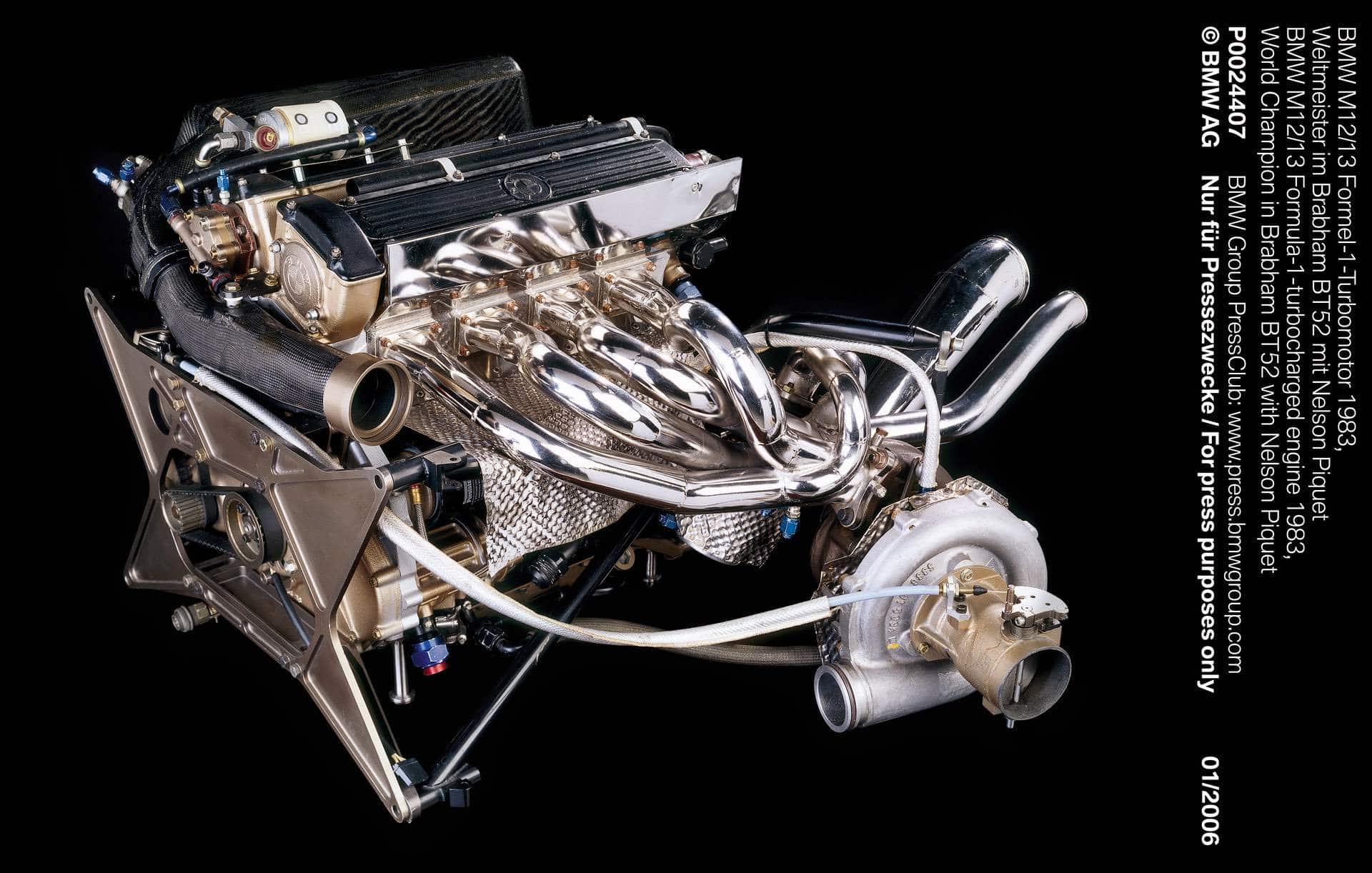
The M12/13, launched with the Brabham team for the 1981 season, had a deceptively simple concept – an inline four-cylinder engine with a single KKK turbocharger. But its execution was anything but easy. The cast iron block featured reinforced main bearing caps and a heavily reinforced bottom end to withstand the brutal stresses of turbocharging. The cylinder head with its four valves per cylinder was optimized for high boost pressures that would have destroyed smaller designs.
The Learning Curve: 1981-1982
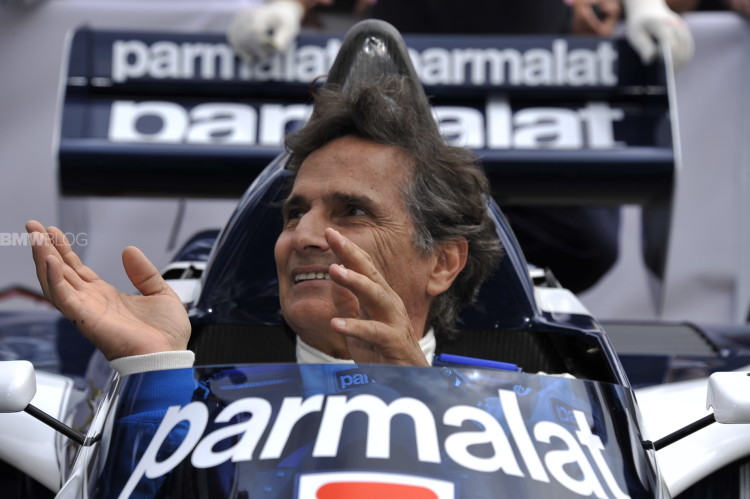
When Nelson Piquet first started the BMW-powered Brabham BT50 in 1981, the engine produced around 560 hp – respectable, but not yet dominant. The Brazilian driver and his team faced numerous starting difficulties: turbo lag which made the car difficult to drive, reliability issues and fuel consumption which meant they were often running on fumes before the checkered flag. But Rosche and his team from BMW Motorsport in Munich were relentless. Over the course of the 1981 season, they refined the engine’s mapping, improved turbocharger response, and steadily increased boost pressure while maintaining durability.
The breakthrough came at the 1982 Canadian Grand Prix in Montreal. Piquet, now driving the improved BT50, stormed to BMW’s first Formula 1 victory. The triumph wasn’t just symbolic – it proved that the four-cylinder concept could work and that Rosche’s unconventional approach was viable at the highest level of motorsport.
Championship glory: 1983
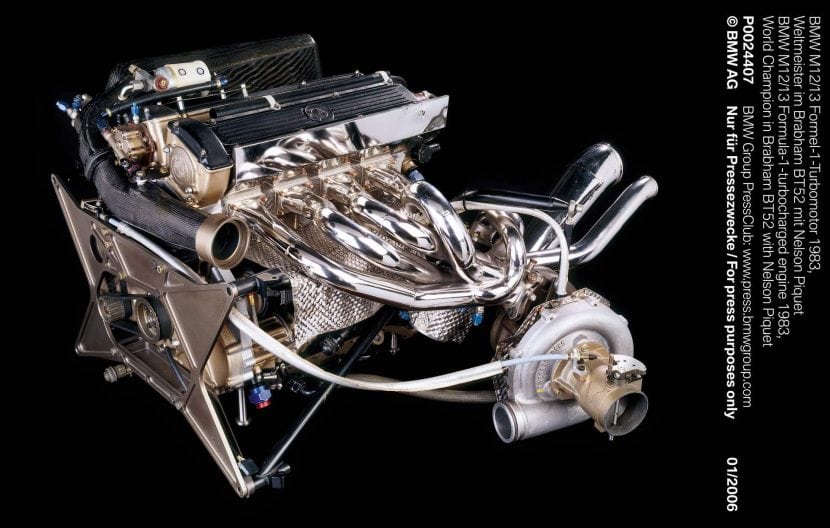
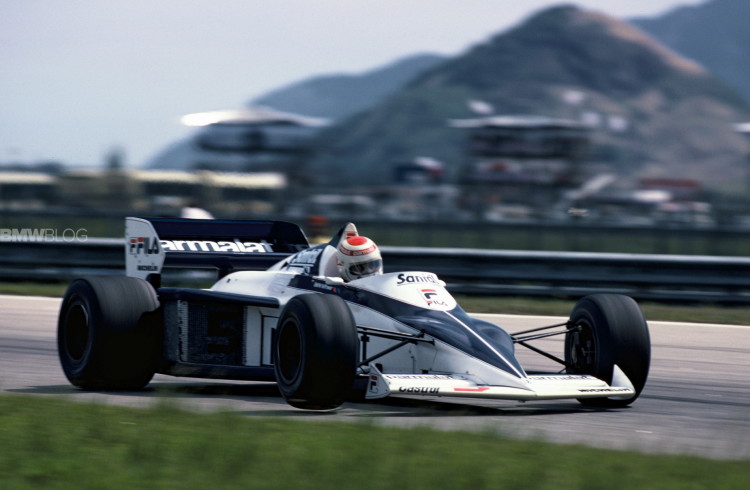
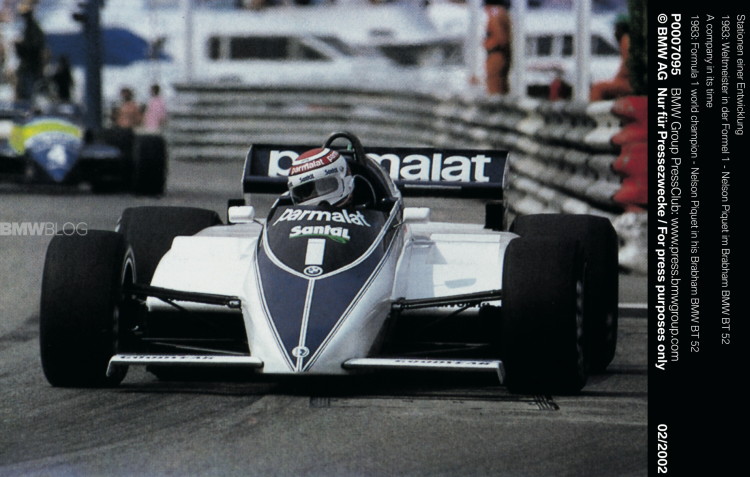
By 1983, the M12/13 had become a fearsome weapon. The BMW engine now powers the revolutionary Brabham BT52 – designed by Gordon Murray with its signature low-line profile – and produced 640 hp in race specification at 2.9 bar boost pressure. In qualifying trim, with increased boost and temporary loss of mechanical sympathy, it could produce more than 850 hp for a few qualifying laps.
The BT52’s wedge-shaped design placed the driver almost in a supine position, lowering the vehicle’s center of gravity and improving aerodynamics. But it was the combination of performance and improved reliability of the BMW engine that made the difference. Piquet drove brilliantly throughout the season, winning three races and collecting enough points to secure the Drivers’ World Championship – BMW’s first F1 title.
The celebration in Munich was euphoric. BMW had proven that German engineering can master the most demanding technical regulations of Formula 1. But Rosche was not satisfied. He knew that the turbo era was leading to an arms race and BMW had to stay at the top.
Evolution: M12/13/1 and the pursuit of power
In 1984, Rosche introduced the M12/13/1 – an advancement that pushed the boundaries of what internal combustion engines could achieve. The improvements were comprehensive: revised cylinder head design, improved fuel injection systems, advanced electronic management and turbochargers capable of withstanding even higher boost pressures.
In racing trim the engine now produced around 750-800 hp, but it was the qualifying mode that captured the imagination and terrified the drivers in equal measure. With a boost pressure of more than 4.0 bar (almost 60 psi), a fuel mixture enriched to the point where it is barely combustible, and with all components operating on the verge of failure, the M12/13/1 could generate up to 1,400 horsepower from just 1.5 liters of displacement.
To put it into perspective, that’s almost 1,000 hp per liter – a specific performance that is unparalleled in the history of Formula 1. The engine produced more power than contemporary sports car prototypes that had double or triple its displacement. It was a mechanical marvel in every way and a testament to Rosche’s genius.
But that power came with caveats. Qualified engines were only used for short laps before being completely disassembled and all components checked or replaced. The turbo lag in full boost mode was spectacular – drivers described lifting the accelerator in fast corners and waiting what felt like an eternity for the boost to kick in in a violent explosion of acceleration that left the rear wheels spinning even in fourth gear.
The customer years: spreading BMW power
BMW’s success with Brabham caught the attention of other teams. From 1983 the M12/13 was available as a customer engine, first for the ATS team (where the young Gerhard Berger made his F1 debut), then for Arrows and finally for Benetton. These customer engines typically had a slight deviation from the Brabham factory specification and had less assistance, but were still impressive. The Arrows team achieved podium finishes, while Benetton showed early signs of competitiveness, which later led to championship success with various engines.
Gerhard Berger’s first F1 victory at the 1986 Mexican Grand Prix in a Benetton BMW was particularly nice for the Austrian. It proved that the BMW engine could win in different chassis and with different teams – a true testament to its fundamental excellence. That Berger later became president of ITR (the organization that runs the DTM series) creates a nice symmetry with BMW’s touring car heritage, from which the M12/13 emerged in the first place.
The technical challenges
The incredible performance of the M12/13 required revolutionary solutions to everyday problems. Fuel consumption was perhaps the biggest challenge. In qualifying trim, the engine could consume so much fuel that the tank would be empty within minutes. Even in race mode, fuel strategy was crucial, with teams often running their cars dangerously lean in the final laps to finish.
Cooling was another constant battle. The intercooler had to reduce the intake air temperatures from almost 200 °C to manageable values through the turbocharger. Radiator size became a compromise between cooling capacity and aerodynamic efficiency.
Added to this was the physical strain on the components. Forces acted on the connecting rods that would have been unimaginable with naturally aspirated engines. Despite its cast iron construction, the block required constant reinforcement and development. Head gasket failures became common early on and required Rosche’s team to develop special sealing solutions.
The end of an era
In 1987, the Formula 1 governing body had seen enough. The turbo engines had become too powerful, too expensive and too dangerous. New regulations limiting boost pressure were introduced to lay the foundation for a total ban on turbocharged engines in 1989. The signs for the M12/13 and its turbocharged brothers were clear.
BMW withdrew from Formula 1 at the end of 1987, choosing to exit at the peak of its technical prowess rather than languish in the twilight of the turbo era. The M12/13 competed for seven seasons, won multiple races, delivered a world championship title and set performance records that stood for decades.
legacy
The BMW M12/13 represents a unique moment in Formula 1 history, when regulations inadvertently created a perfect storm for technical excess. The output of 1,400 hp achieved in qualifying trim has never been achieved in Formula 1, even by today’s sophisticated hybrid drive units with their combined combustion and electric drive sources.
More importantly, the M12/13 showcased the genius of Paul Rosche and the technical prowess of BMW Motorsport. The lessons learned – in turbocharger development, engine management, materials science and thermal management – impacted BMW’s road vehicles and influenced generations of M division products.
Today, original M12/13 engines are kept in museums, including at BMW in Munich. They are occasionally launched for demonstration purposes, their distinctive bark and fierce power delivery reminiscent of an era when Formula One’s technical regulations allowed engineers to pursue pure performance with relatively few restrictions.
