
Electric cars are often accused of lacking emotionality. But the Ioniq 6 N from Hyundai proves the opposite – it offers noise, grip and real driving pleasure.
Electric cars are quiet. That’s usually a good thing, especially on long-distance trips or cruising through residential streets. But when it comes to excitement, silence can be a disappointment. After all, noise is a central part of motorsports. It’s no surprise that the high-pitched whir of Formula E isn’t as inspiring as a V10 roaring around a street circuit. Without sound, speed becomes abstract – and many powerful electric cars lack drama.
This is where the Hyundai Ioniq 6N comes into play. With a top speed of 257 km/h, it is already fast by electric car standards. Thanks to 448 kW (609 hp) all-wheel drive power, it sprints from 0 to 100 km/h in 3.2 seconds – briefly up to 650 hp in boost mode. At around 77,000 euros, it’s not exactly cheap, but considering the performance and standard equipment, it’s a bargain. The similarly fast Porsche Taycan GTS starts at 148,800 euros (without options). At Hyundai, only a handful of extras cost extra.
Both are four-door sedans. The Taycan is larger, but the Ioniq 6N still measures just under five meters and has a wheelbase of almost three meters, so cabin space is generous. However, the exterior is more controversial than you would expect from Hyundai. Its flowing, aerodynamic shape is deliberately different – and in the N trim it gets a black rear panel (regardless of body color) and a dramatic gooseneck spoiler. In comparison, the muscular wheel arches appear subtle.

But this isn’t a styling exercise. “We built it for real racetrack driving,” says Manfred Harrer, head of the performance department at Hyundai N. This means proper cooling of the battery and drivetrain, tested at the Nürburgring. Harrer makes it clear: “Power is easy these days. What counts is endurance, braking and cornering behavior.”
The Ioniq 6N has large brake discs, a variable pedal response depending on the driving mode and strong, confident deceleration. In the most aggressive setting, regenerative braking can reach 0.6 g – enough to feel the seat belt pull when you lift off the accelerator.

The bottom line is that it’s almost a completely different car than the stock Ioniq 6. The suspensions have been revised and adaptive dampers added. The result is a lower center of gravity – even lower than the Ioniq 5 N – and excellent dynamics. It’s compliant on bumpy country roads, while remaining flat and quiet on circuits. It even handles curbs with remarkable aplomb. The torque is distributed to all four wheels with rear wheel bias and totals 770 Nm. A sophisticated torque vectoring system optimizes corner entry and exit, giving the rider real confidence.
So far the Ioniq 6N is simply a fast car. But Hyundai wanted it to be fun too – and in that respect it does something the Taycan doesn’t. The secret lies in its electronics, which transform it into a kind of rolling games console. The focus is on the sound module. This doesn’t make the car go any faster, but it does make it feel faster. The artificial engine sound – rough and harsh – is aimed more at the driver than pedestrians, but gives it character. Luckily, it can be turned off when it gets tiring.
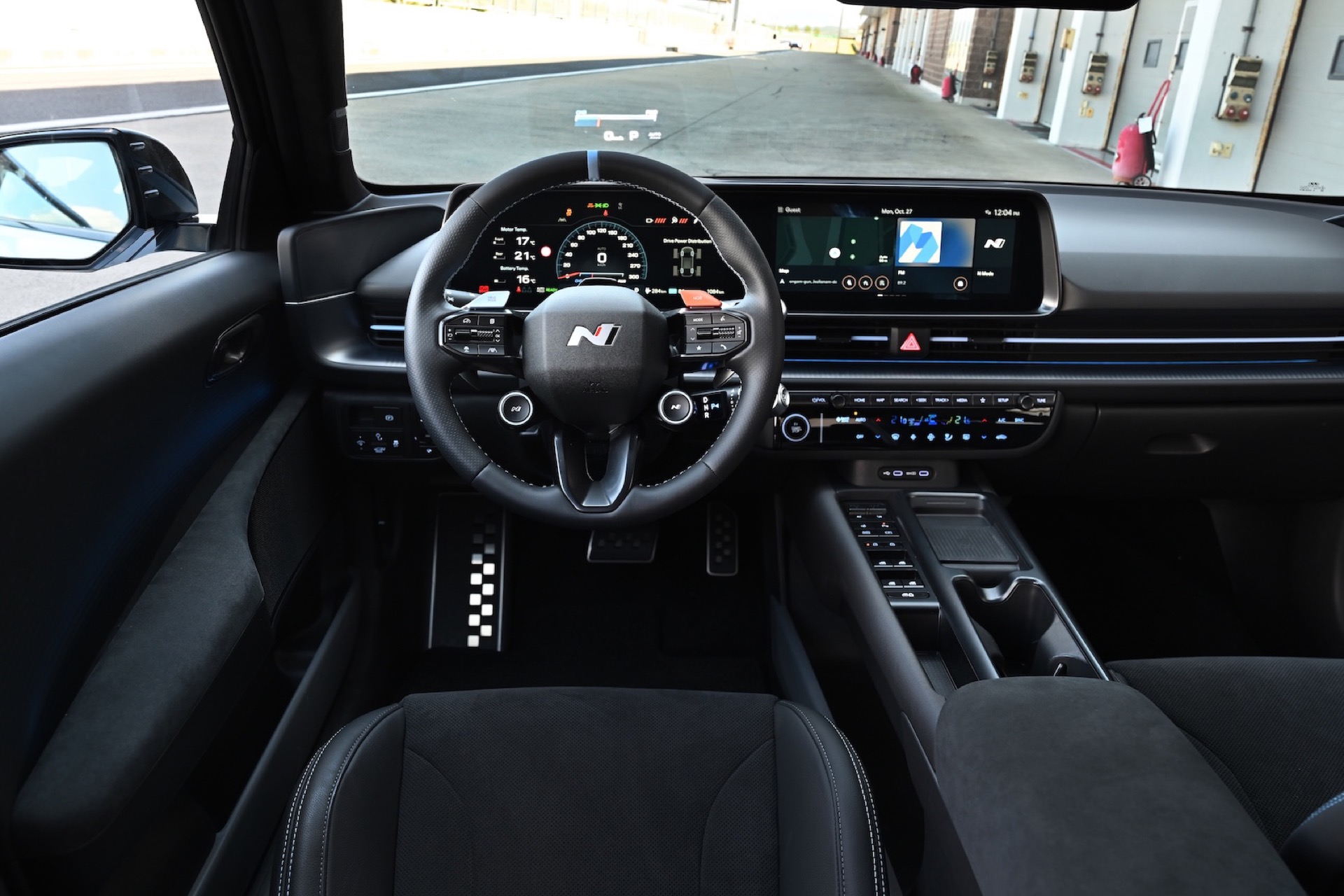
Then there is N e-Shift, a virtual paddle shift transmission. It’s not technically necessary, but it mimics gear changes and provides interactivity – like a well-designed arcade game. The N Track Manager in the infotainment system provides even more depth. You get an on-screen ghost car to track your previous lap, as well as drifting parameters to help even beginners glide with confidence. It’s nerdy, yes – but that’s the point.
For 77,000 euros it’s not a toy. But for under-30s who grew up with virtual cars, the Ioniq 6N brings this digital world vividly into the real world. Think of it as a Taycan for the PlayStation generation – in the best possible way.

