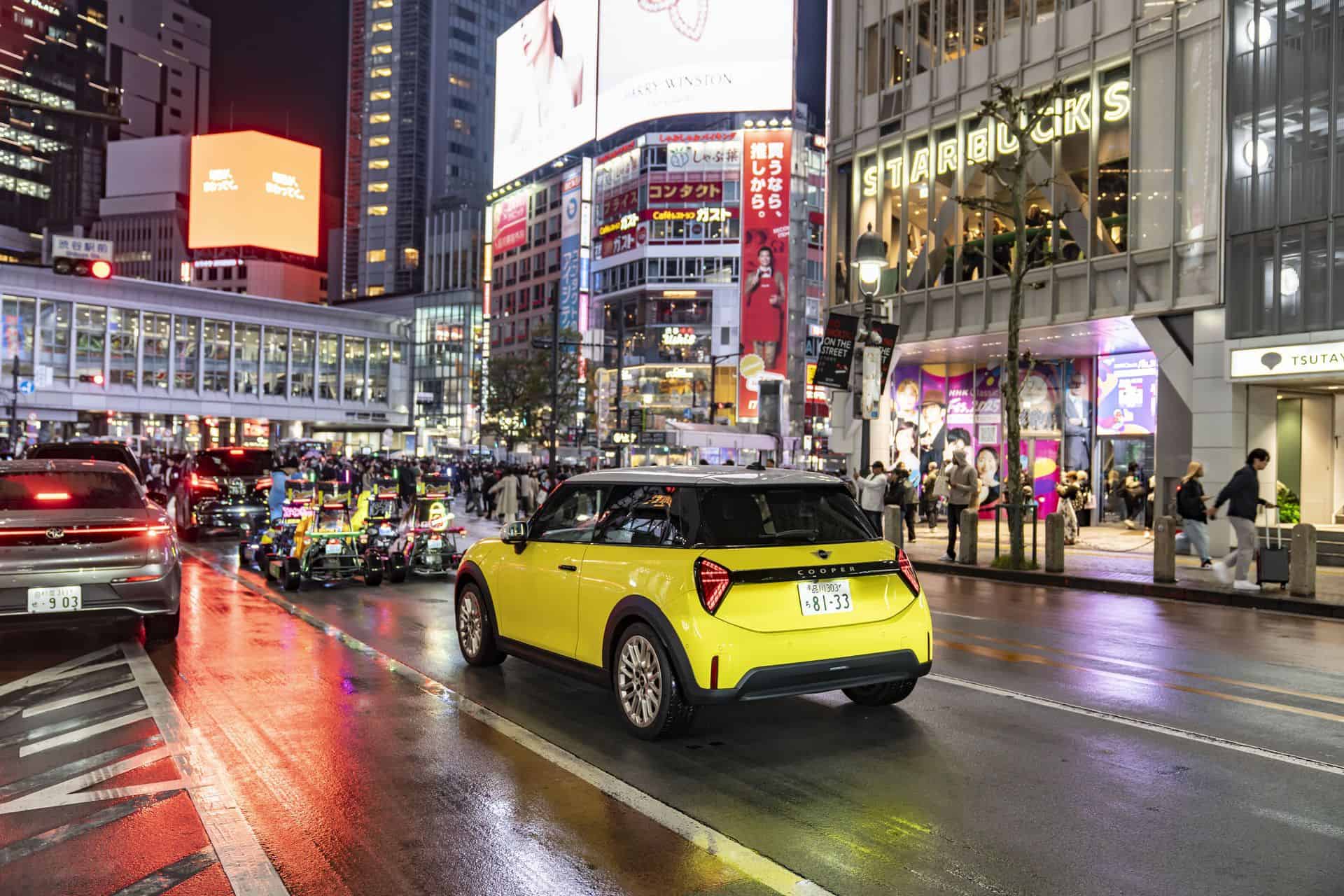
The cheapest ticket to the world of the BMW Group is the MINI Cooper C. In Germany it starts at 28,150 euros, the cheapest BMW is the basic 1 Series at 33,600 euros. Similar to the Bavaria’s entry-level sedan, the Oxford’s base vehicle is highly customizable with numerous personalization options.
A new series of photos from the busy streets of Japan show the F66 in what is probably its most striking color: Sunny Side Yellow. It’s a £600 option, but if you want the contrasting white roof and side mirror caps you’ll have to step up to a more expensive trim. MINI also presents the three-door model with optional 17-inch U-spoke alloy wheels.
Much like previous generations, the latest MINI remains a charming car with only a handful of direct competitors. Opel once tried to compete in this segment with the forgotten Adam, a stylish city car, but the attempt was short-lived. The Smart ForFour has come and gone, while something like a Toyota Aygo X isn’t really a legitimate opponent.

Its closest competitor is the Fiat 500, which recently regained its gasoline engine in response to slow-selling electric vehicles. It also leans heavily on retro design and builds on a decades-long tradition. However, despite the MINI badge, the Cooper is a much larger car. It definitely has more presence than the fancy Italian hatch and feels more substantial.
The Cooper C is at the lower end of the BMW Group range and is not intended for chasing lap records. Its turbocharged 1.5-liter gasoline engine performs at its best in the car’s natural environment: the urban jungle. The 154 hp three-cylinder “B38” engine accelerates the MINI to 100 km/h in a more than respectable 7.7 seconds.
As with all other Oxford models, there is no manual transmission. It’s not the end of the world, considering that switching gears in a crowded city isn’t exactly our thing. However, MINI could have at least given the John Cooper Works hot hatch a third pedal to satisfy enthusiasts. Instead, a seven-speed dual-clutch automatic transmission sends power to the front wheels.
MINI once said it would become an all-electric brand around 2030, but that ambitious goal no longer exists. Similar to its parent company BMW, the British brand will stick to combustion engines for many years to come. I think we can all agree that this is a good thing.
