
After a six-hour flight from Tokyo, I landed in Chengdu – the capital of Sichuan Province and home to more than 20 million people. It’s a city that’s in no hurry to impress you. Life here is slower. The streets are full of teahouses, the smell of stew everywhere and people play mahjong until well after midnight. Compared to Beijing or Shanghai, you feel more relaxed in Chengdu – cheaper to live, easier to breathe.
That’s probably why BMW M chose it for one of the biggest M festivals in the world. The city’s energy matches the brand’s personality – passionate but relaxed, proud but never too serious.
I came here as a guest of BMW M and joined M CEO Frank van Meel and a crowd of enthusiasts who had come from all over China. Some even traveled from Beijing – almost twenty hours away – just to be there.

The Chengdu Tianfu International Circuit is about an hour outside the city, surrounded by the new developments in the Tianfu area. On normal days it is a quiet 3.2 kilometer track used for local racing and testing. This weekend it looked like a small town built entirely around the letter M.

At the entrance, a huge 20 x 10 meter display in the shape of a BMW instrument cluster greeted visitors. It showed the entire setup of the event – from drift areas to art rooms to food courts. Shortly behind, the first thing you heard were tires. The BMW Driving Experience China team already conducted drift demos on the autocross track near the gate. The smell of burning rubber and the sound of the engines bouncing off the limiter immediately set the tone. You didn’t even have time to adjust – the emotions overwhelmed you immediately.
///M Everywhere

Walking through the venue felt like walking through a small theme park entirely dedicated to the letter M. Everywhere you looked, something was happening.
There was the M Record, a kind of museum that celebrates the racing history of BMW Motorsport. Next to it is the M Salon, where guests could have their nails or hair styled in M colors – small, fun touches that gave the place a lively and not over-produced look.

The BMW Collection pop-up shop was packed, selling the latest M gear and motorsport apparel. And in one of the more creative moves, BMW had turned a giant racing helmet into a cafe – literally a full-size helmet structure while people sipped espresso outside.

Then there was the BMW Art Gallery, which housed something special: Cao Fei’s BMW Art Car #18. It’s a piece of modern art that connects the digital world with the physical world, and later in the evening Cao Fei herself appeared to unveil a new PUMA x BMW lifestyle collection inspired by her car. And because every festival needs a place to rest, there was the M Top-Up – a huge outdoor seating area that serves food and drinks right next to the drift track. You could grab a bite to eat while watching M4s slide sideways just meters away.
The Paddocks – a museum, a workshop and a dream

In the paddock, BMW had turned the garages into M Studios. Each focused on something different – racing heritage, current models or what’s next.
The first one I entered immediately drew a crowd: the BMW M3 GTR from Need for Speed: Most Wanted. Yes, this car. The silver-blue legend of an entire generation of gamers is parked right in front of us. People were constantly taking photos. BMW had set up SIM racing cars around it on which visitors could drive digital versions of legendary BMWs such as the M1 Procar or the 3.0 CSL Batmobile.

The next studio focused on the present and the near future. Inside was the new BMW M2 CS in Velvet Blue, the M4 Nürburgring Edition (only 53 examples built for China) and – hidden in plain sight – a camouflaged BMW M2 Track Edition that surprised even those of us who follow every M rumor.

The setup felt authentic. No velvet ropes, no company presentations. Instead, it looked like a functioning M garage: wooden boxes, carbon parts stacked in corners, workbenches with neatly arranged tools.
Between the studios, BMW Motorsport drivers Augusto Farfus, Jens Klingmann and Jesse Krohn held small sessions with fans – talking about racing, technology and what it’s like to drive M and motorsport cars. No stage, no script, just open conversations.
The track comes to life

On the other side of the paddock, dozens of M2s, M3s, M4s and M5s lined the pit lane. Guests were able to sign up for lead-follow sessions with trainers to experience the Tianfu Circuit first-hand.
The track is quite short but technical – fast corners, a few elevation changes and a back straight long enough to stretch the legs of an M3. Watching groups of cars drive off one after the other, the sound of turbo six-cylinder and V8 engines reflecting off the grandstand walls, you can’t help but be mesmerized.

Later in the day, BMW held an M Corso, a parade of official vehicles and customer models. It looked like an M Museum in motion – hundreds of cars, each a little different, each representing the personality of its owner.
Community at the core

With all the hustle and bustle and engine noise, the real highlight was the main stage, which was almost the size of a football field. Here, BMW hosted a curated car show with China’s wildest self-built cars.

I’ve seen everything from gaudy M2s with carbon fiber widebody kits to a KITH-branded E61 5 Series Touring – a combination I never thought I’d see in person. The owners took the stage to talk about their builds, their travels and their love for M. The event was broadcast live on Chinese social media and reached thousands more.
The night show

As the sun set, the temperature dropped and the sound of the engine returned. People gathered again near the main straight. The evening started with some of the day’s highlights – owners, fans and some BMW M racing footage – shown on a huge LED screen.

Then Frank van Meel, CEO of BMW M, and Sean Green, CEO of BMW China, took the stage. They warmly thanked everyone for coming and talked about how important China has become for BMW M. And then came the news everyone was waiting for: The BMW M3 Touring is officially coming to China. The crowd went wild.
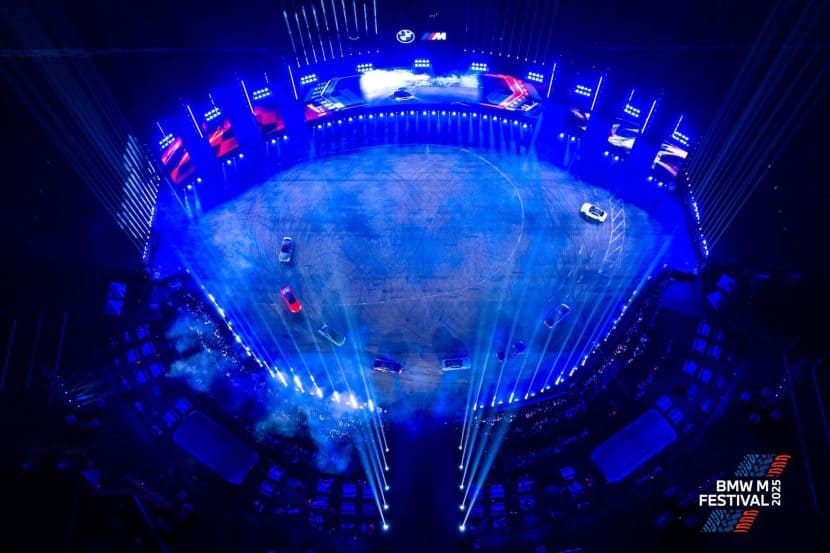
Next the music started – and so did the smoke. More than twenty M cars drifted in synchronized patterns under the lights, moving inches ahead of each other. The soundtrack included “Black Bimmer” by KEAN DYSSO, Kordas and Linius – a crowd favorite in China – blaring from the speakers as people danced, filmed and shouted. It wasn’t just a show. It felt like a party, a shared experience between thousands of strangers who all happened to love the same thing: the most powerful letter in the world.
When it finally ended, it was already late in the evening. I was supposed to leave for my flight to Germany in a few hours, but I stayed as long as I could. The energy was too strong to walk away from.
What makes ///M different

As I left the track, exhausted and slightly deafened by the noise, I realized something: This wasn’t your typical car event. It reflected what M really is today – not just cars, but also people, culture and community.
The Chengdu M Festival was emotional, chaotic, loud and deeply human – all things that make the M brand special. It’s proof that the connection between a driver and an M car still means something real, even in a world that is moving towards electrification and technology.
I almost missed my flight. And honestly, it would have been worth it.
