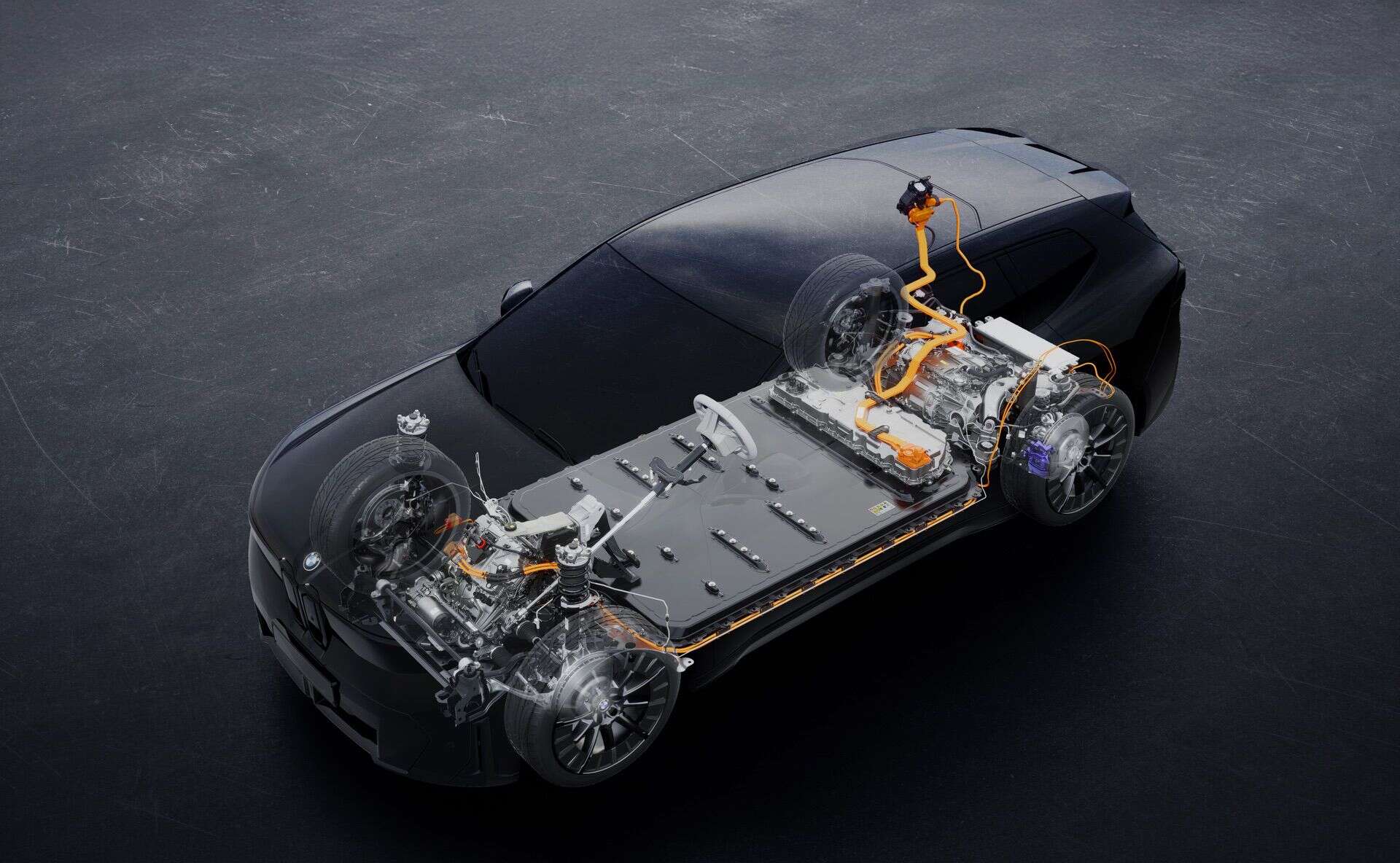
BMW’s sixth-generation eDrive platform is the company’s most comprehensive redesign of its battery, power electronics and charging systems since the original i3. Unlike previous generations that evolved through incremental changes, Gen6 introduces a new battery format, new packing structure, new voltage architecture, new thermal concept, new charging software backend and new energy management strategy. It is a pure system based entirely on electrochemical limits, thermal behavior and real charging data.
800 volt architecture

The heart of the platform is the transition from a 400-volt to an 800-volt battery. The new package uses cylindrical cells arranged in a cell-to-package configuration without modules or structural struts. Removing intermediate housings increases usable volume and reduces electrical and thermal resistance between cells and cooling surfaces. BMW’s cylindrical format was chosen for its lower internal resistance, more even heat distribution and improved fast-charging ion transport – properties essential for achieving high peak charging power and maintaining stability at high current.
What is the Energy Master?

The new packing design is flat and spans the subfloor in a single layer to optimize heat flow, reduce pressure drop in the coolant channels and shorten current paths. BMW also integrates an “Energy Master” unit directly into every high-voltage battery. This central control module manages high and low voltage distribution, battery protection, communication with the charging system and all bi-directional power functions. Because of this architecture, Gen6 vehicles do not require additional hardware for V2H, V2G or V2L. All necessary components are integrated into the package and drive electronics, so the bi-directional capability does not add any additional weight to the vehicle.
400 kW charging
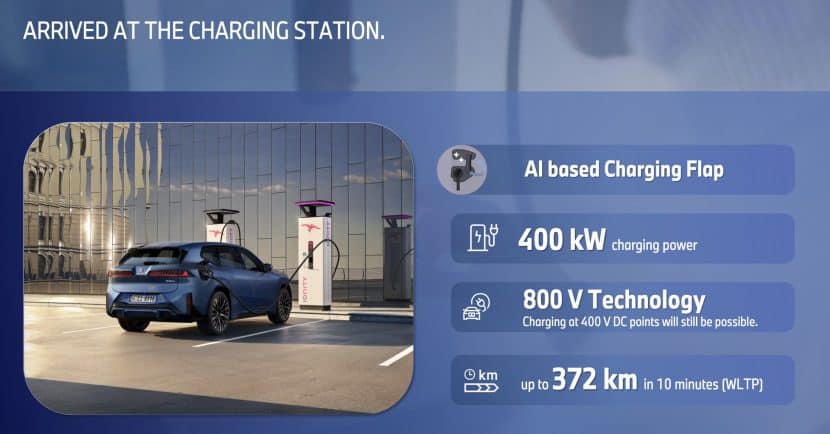
One of the most important aspects of Gen6 is the way the battery is charged. At a workshop in Spain, engineers were asked directly how the new iX3 50 xDrive achieves its peak value of 400 kW during fast charging and how long it lasts. Their answer established a clear principle: the charging curve is defined solely by cell chemistry and internal resistance, not by software smoothing or idealized goals. The battery does not attempt to maintain peak performance beyond what the cells can accommodate.
Peak charging power is available at just over ten percent charge level. The packet is unable to receive the full stream at the bottom of the SOC window; Internal resistance and voltage behavior at very low charges require a short setup. Once this threshold is exceeded, the pack will hold 400kW for about three minutes before naturally settling into a sustained high-power plateau. This plateau lasts until just over twenty percent SOC. From this point on, the combination of increasing cell voltage and thermal stress forces the system to rejuvenate.
BMW emphasized that the vehicle charges directly at the “cell boundary line,” i.e. the maximum safe current allowed by electrochemical constraints at each SOC. Nothing in the curve is artificially shaped for optical reasons. The tapered profile is entirely determined by the physics of the cylindrical cells.
This curve shape is central to BMW’s approach to long-distance charging. The company demonstrated the system using a real route between Málaga and Barcelona – around 895 kilometers. When starting with sufficient charge, the My BMW app calculated a one-time charging stop of around twenty minutes. The accuracy of this guide depends on the backend improvements introduced with Gen6. The first is an AI-powered geolocation correction layer for public chargers.
According to BMW, more than half of the public charging points in provider databases are incorrectly placed on the map. Its AI system uses telemetry from the fleet charging session and approach direction data to calculate the actual position of the charger. The correction can move a POI by tens of meters, enough to eliminate common navigation frustrations such as: B. when chargers are placed on the wrong side of a parking garage or on an inaccessible street.
Lots of backend processing to make loading smarter
The second backend improvement is BMW’s “Power Learning” system, which records the highest charging power ever achieved by a BMW vehicle at each station. This allows the route planner to replace optimistic operator-specified values with observed real numbers. If a charger is rated for 350 kW but has never delivered more than 170 kW, the car will display this value and schedule charging stops accordingly. This helps position charging within the narrow SOC window where the battery can actually maintain high performance. Together, these two backend systems narrow the gap between advertised charging conditions and what drivers actually experience.
Bidirectional charging
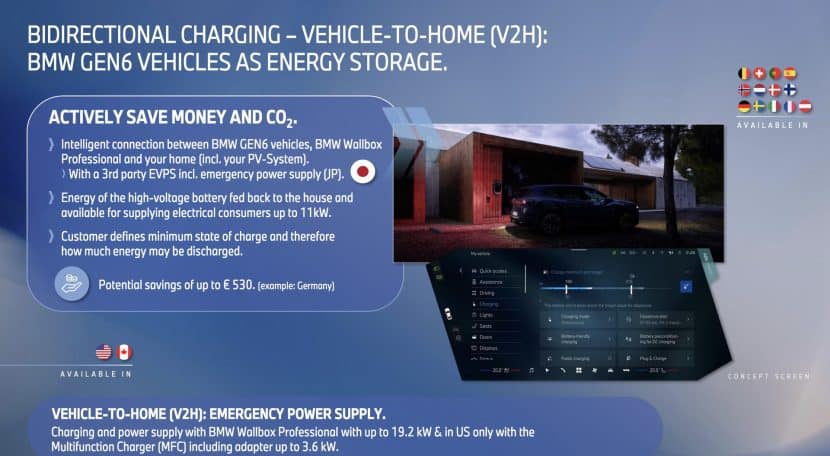
Charging hardware and power management features go beyond fast charging. Gen6 introduces a fully bidirectional power interface. Vehicle-to-Home (V2H) operation feeds energy directly from the high-voltage battery into a home via the BMW Wallbox Professional. In Europe the system supports up to 11kW bidirectional operation. In the USA, the same wallbox is rated up to 19.2kWreflecting different residential electrical codes. BMW estimates that a typical home equipped with renewable energy could save hundreds of euros per year by charging during low-cost periods or storing excess solar energy for evening use. The vehicle automatically manages its minimum SOC destination and departure time requirements; The user only defines the boundaries.
BMW is also supporting vehicle-to-grid (V2G) operations, starting with a commercial launch in Germany through a partnership with E.ON. Engineers emphasized that grid services rely on flat cycling within medium SOC windows to limit battery wear. BMW’s internal testing shows that the resulting deterioration remains within the limits of normal use.
Vehicle-to-Load (V2L) is implemented worldwide through the multifunctional charger. This AC-based system allows the car to power tools, household appliances or small appliances with up to 3.6 kW. Adapters can be used to support multiple devices at once, and in the US the multi-function charger also provides a simple backup power feature for key circuits, although the DC wallbox is still required for whole-house support.
Different AC charging in the USA
The workshop resulted in a point of clarification regarding markets and AC charging. While European customers can choose between 11 kW and 22 kW AC onboard charging power, BMW will deliver all iX3 models sold in the USA with AC Charging Professional as standard. This option includes an integrated charger with a rated power of approx 15.4 kW AC and also enables the full range of bidirectional functions. BMW says a full 0-100 percent AC charge takes about 7.5 hours using the 15.4kW onboard charger, but the figure has yet to be confirmed before launch.
Closing the loading flap via AI
Another feature introduced with Gen6 is the AI-controlled tailgate. The flap opens automatically when the car approaches a planned quick-charging stop or when it detects the direction and angle of approach to a known charging location, such as a house driveway. A manual override remains, but the automation is intended to eliminate an additional step during the loading routine.
